Let's start with the rule that matters more than all the others put together: never stand, walk or kneel on a conservatory roof. Not glass, not polycarbonate, not "just for a second". The panels and glazing bars are designed for spread-out wind and snow loads, not a person's concentrated weight, and the UK's biggest roof-system manufacturer explicitly warns against even testing whether yours will take you. Everything below happens with both feet on the ground.
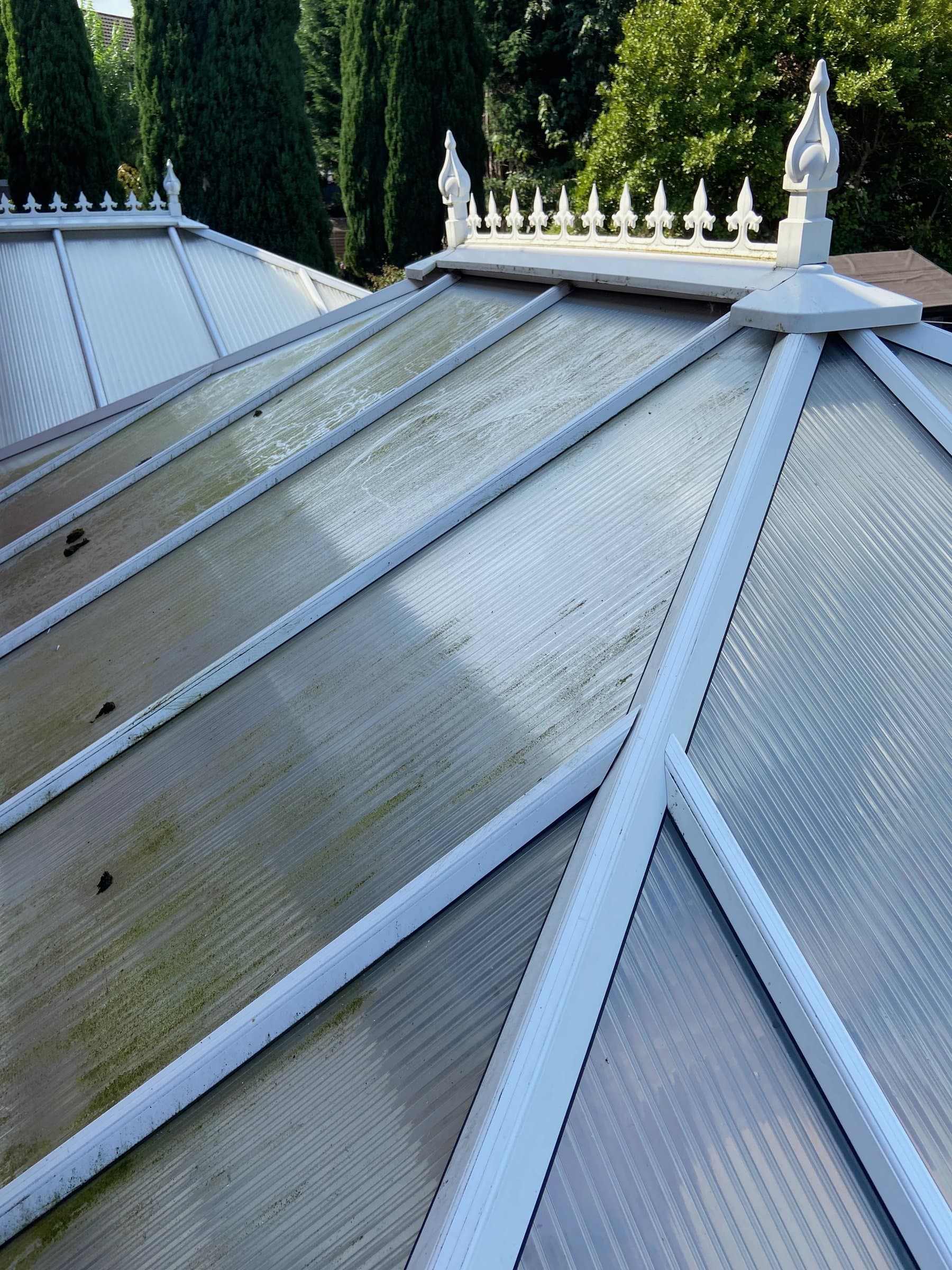 Before
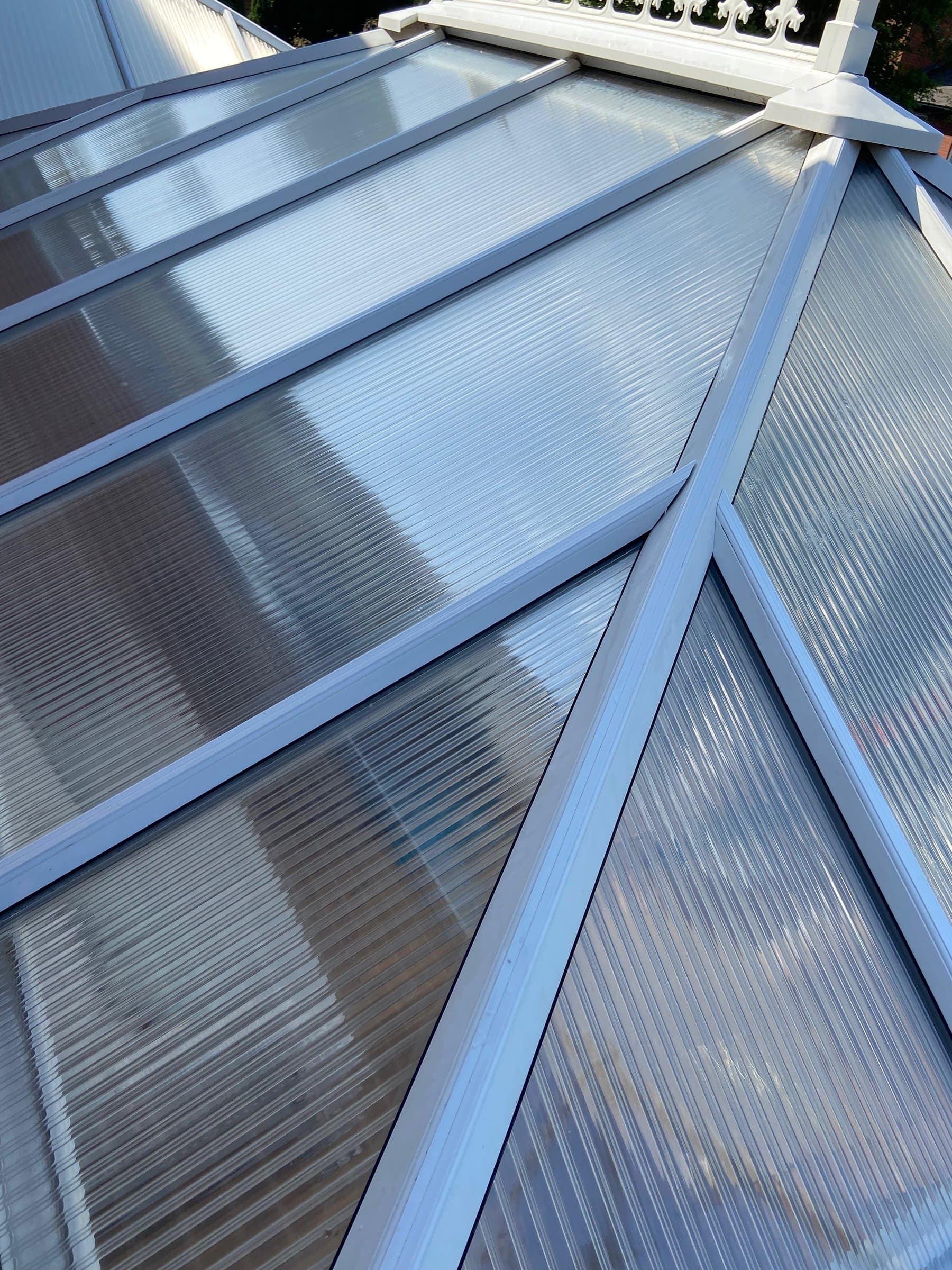 After
AfterHow a conservatory clean is done properly
Identify the roof and check its condition
Glass, polycarbonate and self-cleaning glass all take different treatment, polycarbonate scratches and clouds easily, and self-cleaning glass has a coating that abrasives destroy. And if panels are cracked or seals perished, the roof needs repair before cleaning: water on a damaged roof makes leaks worse.
Close up and protect what's below
Every window, door and roof vent gets closed so nothing runs inside, and plants and furniture under the run-off line get moved or covered before any cleaning starts.
Brush off the dry debris first
Leaves, twigs and loose dirt come off with a soft brush while everything is still dry, wet debris just smears across the panels.
Wash top-down with the right brushes and pure water
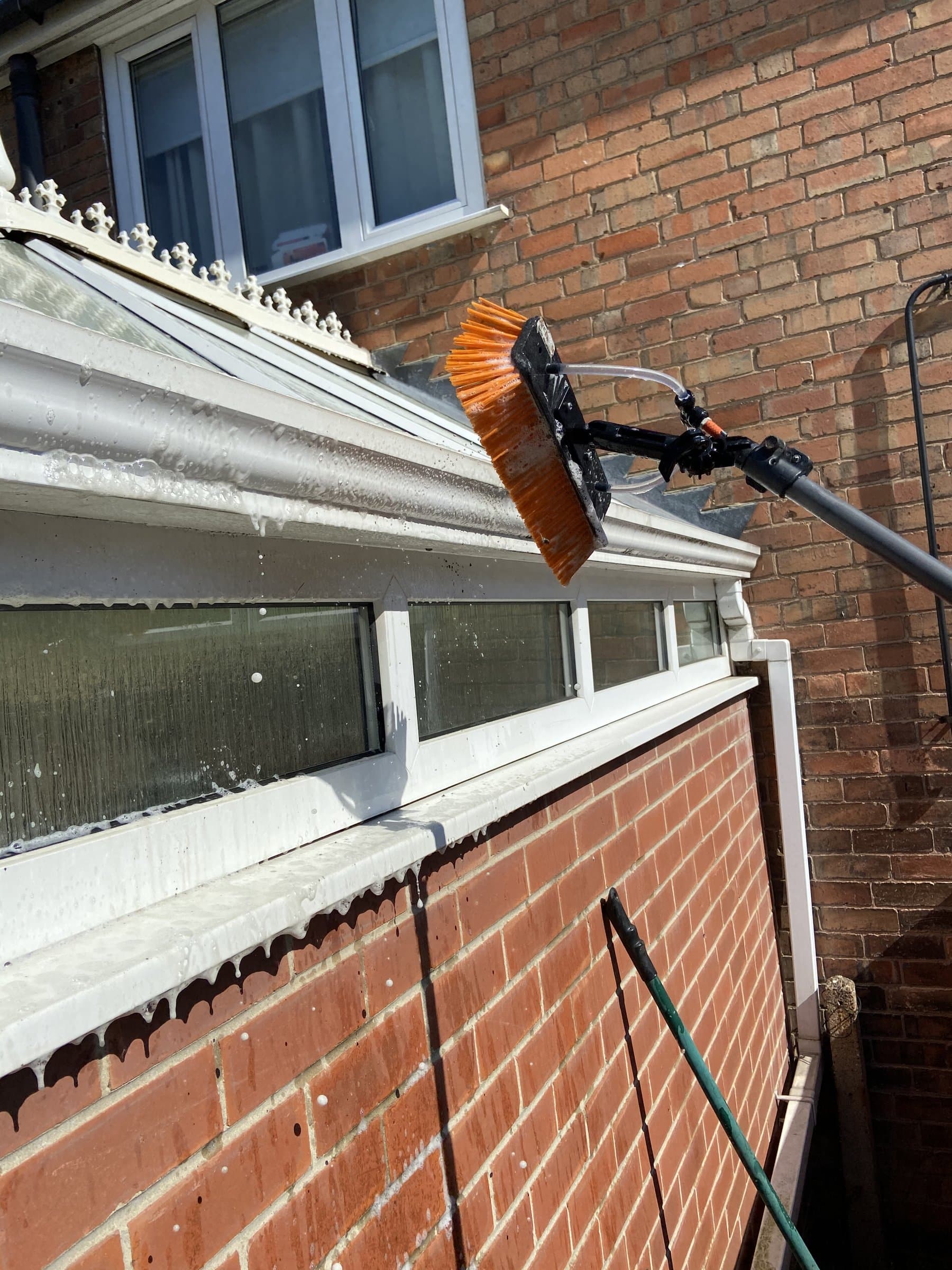
Starting at the ridge and finials and working down the panels, so dirty water flushes toward the gutters rather than over cleaned sections. We use soft brushes, pure water and a gentle technique matched to the panel type, no harsh pressure on the panels, ever.
Rinse low-pressure, never a pressure washer
The rinse is hose-pressure, working downwards. High pressure forces water under the rubber weather seals and can blow the hermetic seals on double-glazed units, and misted double glazing is permanent, not something that dries out.
Clear the gutters, especially the box gutter
The conservatory's own gutters get cleared so they actually drain. The critical one is the box gutter where the conservatory meets the house: when that blocks, it overflows into the adjoining wall and ceiling, and it's a leading cause of conservatories leaking inside.
Every bit of plastic, then the glass last
If we clean a conservatory, we clean all the plastics, frames, glazing bars, trims and sills, washed with warm soapy water and nothing abrasive (solvents and cream cleaners permanently dull uPVC). The vertical glass goes last, once nothing dirty can run down over it.
Getting the solution right: time, heat and dilution
Spraying a solution on and hosing it off is the easy part. Doing it without marking the plastic is where the craft is, and it comes down to a balance the trade calls Sinner's Circle: time (how long the solution is left to dwell before it's rinsed), heat (the temperature it's working at), dilution (how strong the mix is), and the gentle agitation of the brush. They trade off against each other, ease one down and another has to come up to get the same result. A milder, safer dilution needs longer to work; a cold day needs more time than a warm one.
What makes it judgement rather than a recipe is that the weather won't sit still. Sun on a panel warms the surface and dries the solution faster; wind does the same, both quietly shorten the working time whether you want them to or not. So the dwell is never a number off the back of a bottle: it's read on the day, the surface watched, worked in smaller sections when it's hot so nothing dries on before it's rinsed. Leave a solution on uPVC too long, or mix it too strong, and you can dull or mark the very plastic you set out to clean, which is exactly why it's a skill, not a spray-and-walk-away.
The box gutter, the leak nobody diagnoses
If your conservatory drips along the wall where it joins the house, the odds are it's not the roof, it's the box gutter above that join, quietly blocked with moss and debris. It sits exactly where you can't safely see or reach it, which is why it gets missed. After heavy rain, check inside along that join: damp patches or drips there are the box gutter telling you it needs clearing. It's part of every conservatory clean we do, because cleaning the roof and ignoring the gutters just washes the debris into an already-struggling drain. And worth knowing: book a full-house gutter clearance alongside a conservatory clean and we'll clear the conservatory's own lower gutters free while we're there.
What you can safely do yourself
Inspect twice a year, from the ground or an upstairs window
Green film on the panels, debris at the ridge, plants growing in the gutters. All visible without leaving the ground.
Wash what you can reach
Frames, doors and glass reachable with both feet on the ground: warm water and washing-up liquid, dried with a microfibre cloth. It's the same baseline solution the professionals use.
Low lean-to roof? A telescopic soft brush from the ground
If, and only if, you can reach it with both feet planted, a soft telescopic brush with hose-fed water keeps a low roof presentable. If you can't reach it from the ground, it's a professional job. No exceptions involving ladders and leaning.
Self-cleaning glass: just hose it
If you have self-cleaning glass, the manufacturer's actual maintenance instruction is to hose it down with clean water in dry spells and let it dry naturally. Never use abrasive pads or metal squeegees on it, they scrape off the microscopic coating and the self-cleaning effect is gone for good.
When to stop
The roof itself, the box gutter, and heavy established algae on polycarbonate, all professional territory. The reasons are physical, not commercial: the roof can't take your weight, the box gutter can't be safely reached, and polycarbonate scratches under the aggressive scrubbing that established growth demands. If reaching something means a ladder against the conservatory or leaning out over the roof, stop there.
How often, and what it costs
Twice a year is the standard rhythm, spring to shift the winter grime and algae, late autumn to clear leaves before the wet season, more often under trees. Typical UK prices run roughly £80–£250 for a roof clean depending on size and access, more for a full inside-and-out valet. Ours is priced from photos: send a few on WhatsApp showing the roof and access, and we'll give you a clear price, confirmed before any work starts.